California homeowners are sitting on untapped rental income and property value potential, but unfortunately, confusion about the accessory dwelling unit laws in California keeps many from taking action. Conflicting information about state minimums versus local regulations leaves property owners uncertain about exactly how many ADUs they can legally build.
Eliminate the guesswork and work with professionals. Experienced San Diego ADU design services can cut through the regulatory complexity and help you maximize your property's capacity. This guide explains precisely how many ADUs you can build on my property based on property type, updated 2025 California ADU development laws, and San Diego-specific bonus programs.
California's ADU Framework: State Law Sets the Baseline
California Government Code Section 65852.2 establishes statewide minimums that override restrictive local zoning, giving property owners guaranteed rights to ADU development. These baseline requirements serve as your starting point for determining your property's capacity. San Diego must comply with these state mandates while offering additional bonuses that can further increase how many units you're allowed to build.
How State Preemption Changed Everything
Before 2016, cities could impose restrictive requirements that effectively prevented accessory dwelling unit construction, burying homeowners in discretionary review processes and public hearings. Current state law requires ministerial approval based on objective standards, eliminating the bureaucratic barriers that were once a barrier to ADU projects.
Important note: According to California Government Code Section 65852.2, local agencies cannot impose minimum lot size requirements or other subjective criteria that effectively ban ADU construction.
What Counts as a Multifamily Dwelling?
A multifamily dwelling is any building with two or more dwelling units on a single lot, including duplexes, triplexes, fourplexes, and apartment buildings. Why does this distinction matter? Multifamily properties follow different rules from single-family residential properties. The regulations for existing multifamily dwelling structures offer substantially higher ADU capacity potential, making them attractive opportunities for property owners seeking maximum density.
State law provides the foundation for how many accessory dwelling units you can build, but actual capacity varies by property type and local programs. Let's examine the specific limits for different property classifications.
Single-Family Properties: Build Up to Three Units
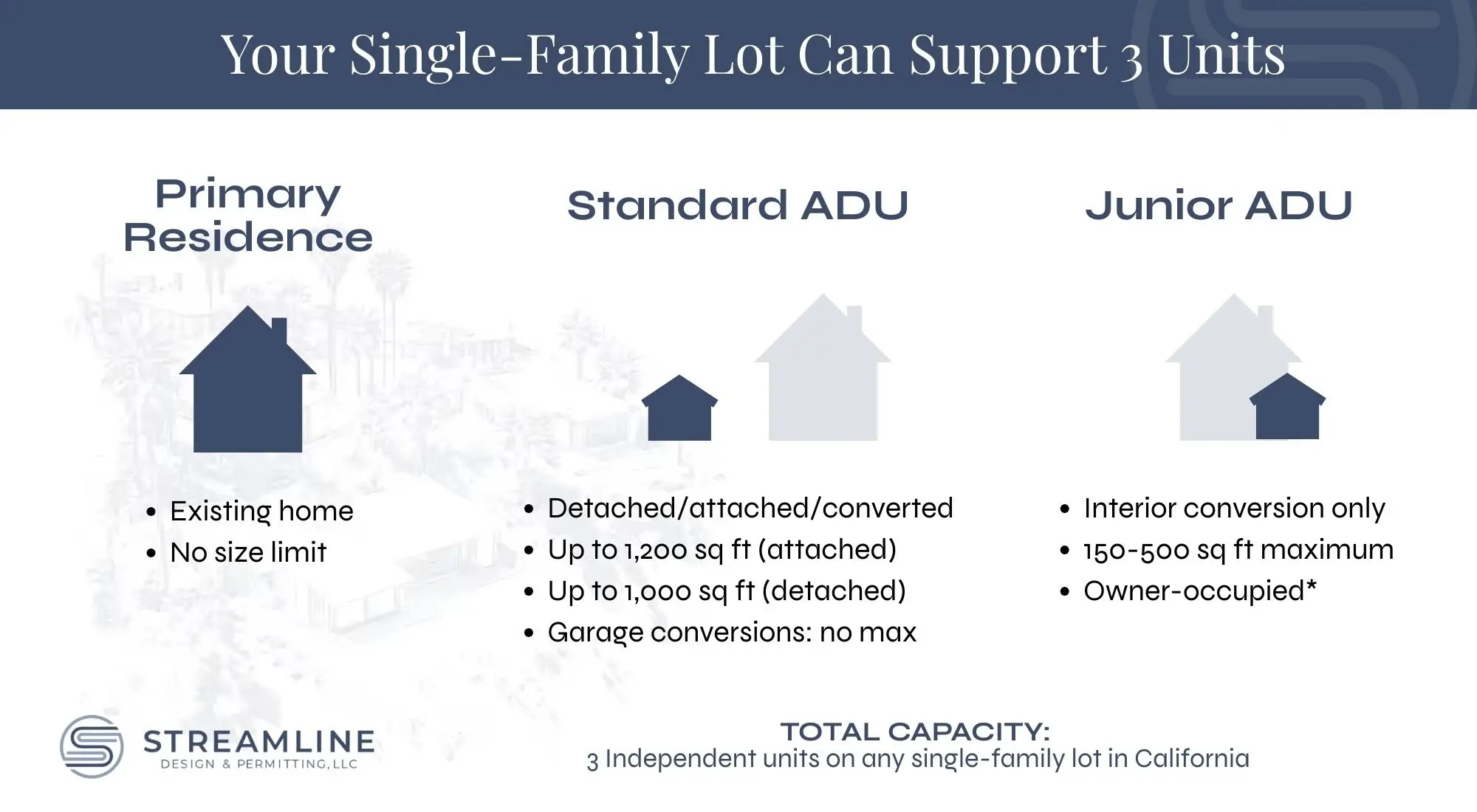
Single-family residential lots have a guaranteed right to triple their density under California ADU laws. This formula combines the primary residence with two types of accessory structures.
The Primary Residence + ADU + JADU Formula
Every single-family residential lot can support one primary dwelling unit, one standard accessory dwelling unit, and one junior accessory dwelling unit. The standard ADU can be detached ADUs, attached ADU structures, or converted from existing space, such as a detached garage. This creates legal triplex-style density in areas traditionally zoned for single homes, fundamentally changing what's possible on single-family lots.
Standard ADU Size and Placement Options
State law provides flexibility in how you configure your accessory dwelling unit, with different size allowances based on construction type.
- Detached new construction: State regulations require local agencies to permit at least 850 square feet for one-bedroom detached ADUs or 1,000 square feet for two or more bedrooms, with mandatory 4-foot side and rear setbacks. These San Diego ADU setback requirements make it possible to fit new construction on most standard lots.
- Attached new construction: Attached ADU structures cannot exceed 1,200 square feet or 50% of the primary dwelling size, whichever is less. This proportional approach is designed to ensure the accessory unit complements rather than overwhelms the existing structure.
- Garage or structure conversions: Conversions of existing structures have no maximum size limit and aren't subject to the 1,200 square foot cap, making garage ADU conversion the most cost-effective option for many homeowners looking to create livable space from existing non-habitable space.
Junior ADU Requirements and Restrictions
Junior accessory dwelling units are interior conversions within the primary residence with a 500 square foot maximum and 150 square foot minimum. JADUs may expand the home's footprint by up to 150 square feet for entry access only, though parking requirements are waived for these smaller units. In 2023, owner occupancy requirements for standard ADUs were permanently eliminated under AB 976, though keep in mind that some junior accessory dwelling unit restrictions may still apply locally depending on your jurisdiction.
Multifamily properties follow different rules, with potentially higher capacity limits for those seeking to maximize their ADU development potential.
Multifamily Properties: Understanding Your Expanded Capacity
Multifamily properties have two separate pathways for ADU development: internal conversions of existing non-habitable space and detached new construction. These pathways aren’t mutually exclusive, allowing property owners to pursue both simultaneously for significant density additions. Recent legislation, particularly SB 1211, dramatically increased the potential for new detached units on existing multifamily dwelling structures.
Internal Conversion ADUs: The 25% Rule
Property owners can convert non-habitable spaces like storage rooms, basements, boiler rooms, or laundry facilities into complete independent living facilities. California law requires local agencies to permit a minimum of one ADU, with a maximum of 25% of existing units available for conversion. For example, an 8-unit building could add 2 conversion ADUs by transforming unused space into dwelling units.
Important note: Junior accessory dwelling units are not permitted on multifamily properties under California law, focusing these projects on full-sized accessory dwelling units instead.
Detached New Construction: From Two to Eight ADUs
Multifamily property owners have a guaranteed minimum of two detached ADUs under state ADU law. However, state guidance indicates that as many as eight detached ADUs may be possible, depending on site characteristics. While state law guarantees at least two newly constructed detached units, updated regulations allow for up to eight detached ADUs on lots with existing multifamily dwelling structures.
Actual feasibility depends on lot size, ample space for construction, and compliance with setback requirements and height limits. Few properties have sufficient land area to accommodate eight full-size units even with minimal 4-foot setbacks, so this is an upper ceiling as opposed to a common outcome.
Combining Both Pathways for Maximum Density
Developers can simultaneously pursue internal conversions AND detached new construction to maximize total dwelling units. A 12-unit apartment building could potentially add 3 conversion ADUs (25% of 12 existing multifamily dwelling units) plus 2-8 two-detached ADUs, depending on available land. This approach is California's most aggressive density allowance for residential properties, addressing California's housing shortage through infill development on existing multifamily dwelling structures.
For property owners willing to include affordable housing components, San Diego bonus programs can further increase these baseline capacities.
San Diego Bonus Programs and Local Exceptions
San Diego offers additional incentives beyond state minimums for properties that meet specific criteria. These bonus programs can significantly increase allowable ADU count while supporting the city's affordable housing goals.
- Affordable Housing ADU Bonus: San Diego's ADU Affordability Bonus Program allows additional market-rate accessory dwelling units when developers commit to building affordable ADU options with 15-30 year covenants at 80-120% of area median income. Multifamily property owners can add 2-4 additional units beyond state minimums through this program.
- Transit-oriented development incentives: Properties within a half-mile of major transit stops receive height bonuses allowing 18-20 foot detached ADUs compared to standard 16-foot limits, creating opportunities for garages with an ADU above. Parking requirements are reduced or eliminated in these zones, lowering overall project costs.
Practical considerations ultimately determine whether these theoretical maximums translate into actual built units.
What Determines Your Actual ADU Capacity?
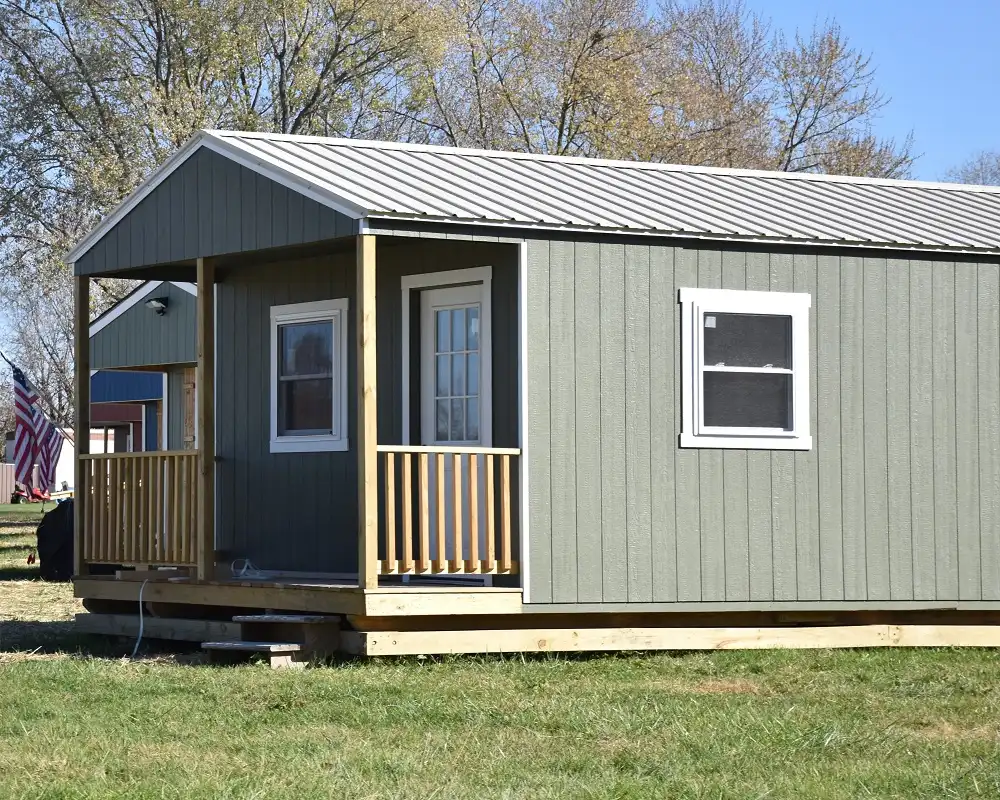
While state law establishes how many ADUs you can have in California, real-world constraints often limit what can actually be built. Lot size, existing structures, utility capacity, and budget serve as the primary determining factors for most ADU projects.
- Lot size and configuration: Available land area, existing structure footprints, and mandatory setbacks determine feasible ADU placement. Properties with large unused areas, like surface parking or rear yards, have the most capacity potential, while constrained urban lots may only accommodate converted existing space.
- Utility infrastructure: Water, sewer, and electrical capacity can limit the number of units you can add, especially when building multiple ADUs. Adding several dwelling units may require utility upgrades, including separate meters or service line increases that add substantial costs.
- Zoning overlays: Coastal zones, historical districts, or specific planned communities may have additional design standards through local coastal program requirements or other overlays. These don't eliminate ADU rights but can affect the approval process and design options.
- Budget and financing: Construction costs and available financing often act as guardrails on how many units property owners actually build, even when more are legally permitted.
We understand that cost considerations determine the practical limit on ADU development, making financial planning essential.
How Much Does It Cost to Build Multiple ADUs?
Construction costs typically range from $200,000 to $400,000 per ADU in San Diego, with significant variation based on size, type, and site conditions. Knowing these cost implications is essential for determining how many ADUs are financially feasible to build on your property.
Keep in mind that these estimates vary significantly based on finishes, site conditions, and permit fees. If a property needs substantial sitework or utility upgrades, it may see costs at the higher end of these ranges.
We’ve provided these cost ranges that reflect current San Diego market conditions to help property owners make informed decisions about how many accessory dwelling units to pursue.
Recent California ADU Laws Affecting Capacity (2025 Updates)
California continues refining ADU regulations, with new legislation taking effect in 2025. These changes further expand homeowner rights and clarify previous ambiguities in state ADU law.
SB 1211: Expanded Multifamily Capacity
According to recent legislation, SB 1211 clarified and expanded the number of detached ADUs allowed on multifamily properties. This bill established clearer guidelines for the "up to eight ADU" interpretation on qualifying lots with existing multifamily units.
SB 1211 is California's most significant expansion of multifamily ADU rights since the original 2016 reforms, allowing property owners to maximize density on existing multifamily dwelling structures.
AB 2533 and Other 2025 Changes
AB 2533 modified fee structures and approval timelines for certain ADU projects, particularly those in transit-oriented zones. The legislation streamlined the approval process for local jurisdictions and clarified when reduced sanitation facilities requirements apply. San Diego homeowners benefit from faster processing times and clearer design standards under these updated regulations.
Important note: Local ordinances that conflict with updated state laws are considered null and void, ensuring homeowners can exercise their full rights under current legislation even if city staff references outdated local zoning laws.
To maximize your property development potential, you’ll want to stay current with these legislative changes.
Ready to Maximize Your Property's ADU Potential?
California's ADU laws allow single-family properties to build up to three total units (primary residence + ADU + JADU), while multifamily properties can add significantly more through conversions of existing non-habitable space and detached construction. If you’re ready to get started, make sure to partner with a trusted and seasoned team.
Streamline Design & Permitting brings 25+ years of experience in San Diego architectural drafting services with proven expertise in maximizing ADU capacity while managing complex local regulations. We've successfully permitted 45+ projects, helping property owners transform single-family residences and multifamily dwellings into income-generating assets. Contact us today for a free consultation.