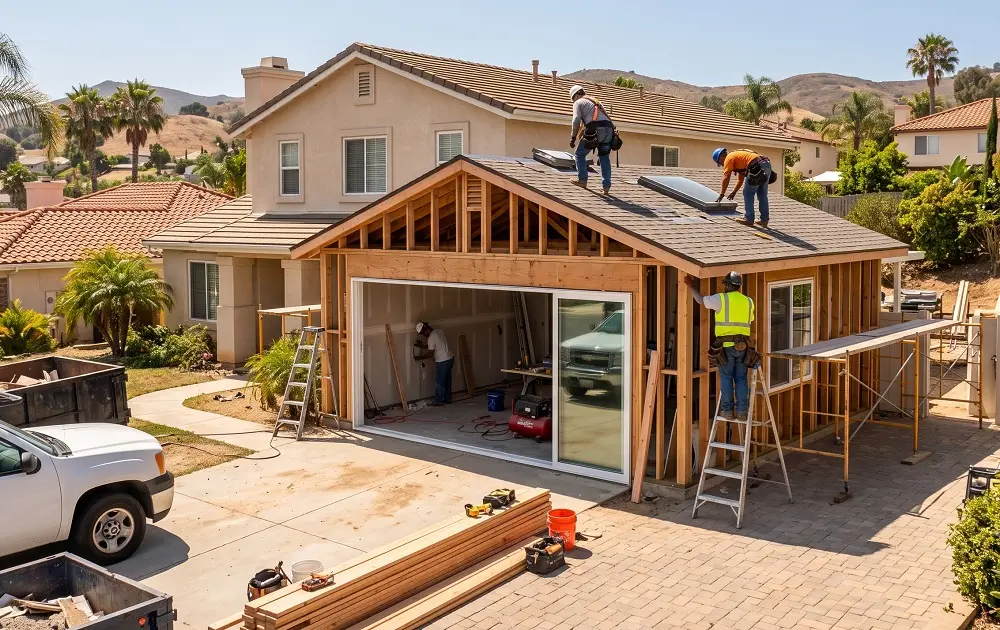
If you're planning to add an accessory dwelling unit in Los Angeles County, the Los Angeles ADU ordinance is the most important document governing what you can build and how fast your permit moves. Small design mistakes can have big consequences, leading to correction letters, additional revisions, and a longer wait for permit approval.
This guide breaks down the Los Angeles ADU ordinance in plain language: what it requires, where state law takes over, and what homeowners in the city of LA must get right from the start to gain permit approval without unnecessary delays.
What Is the Los Angeles ADU Ordinance?
The City of Los Angeles adopted its ADU ordinance on December 11, 2019. Known as Ordinance 186,481, it created a new section of the Los Angeles Municipal Code — LAMC Section 12.22A.33 — that governs Accessory Dwelling Units, Junior Accessory Dwelling Units, and Movable Tiny Houses. In Los Angeles, the Los Angeles Department of Building and Safety (LADBS) handles permit reviews under this ordinance.
The ordinance was designed to align Los Angeles with California state ADU law, specifically Government Code Sections 66313 through 66342, while adding local development standards suited to the city's diverse neighborhoods and lot conditions. State law generally takes precedence when it conflicts with local rules, and it often allows homeowners to build more than local ordinances would otherwise permit.
Applications for ADU permits in Los Angeles are reviewed ministerially, meaning no public hearing, discretionary review, or CEQA environmental process is required for qualifying projects. This is one of the most significant protections California's ADU framework provides to property owners.
ADU Types Recognized Under LAMC 12.22A.33
The LA ADU ordinance recognizes several distinct unit types, each with its own development standards.
Detached ADUs
A detached ADU is a freestanding structure built on the same lot as the primary dwelling. Under the Los Angeles ADU ordinance, detached ADUs are allowed up to 1,200 square feet and may be one or two stories. The unit must include its own kitchen, bathroom, sleeping area, and separate entrance to qualify as a fully independent dwelling. Detached ADUs cannot exceed two stories under local code.
Attached ADUs
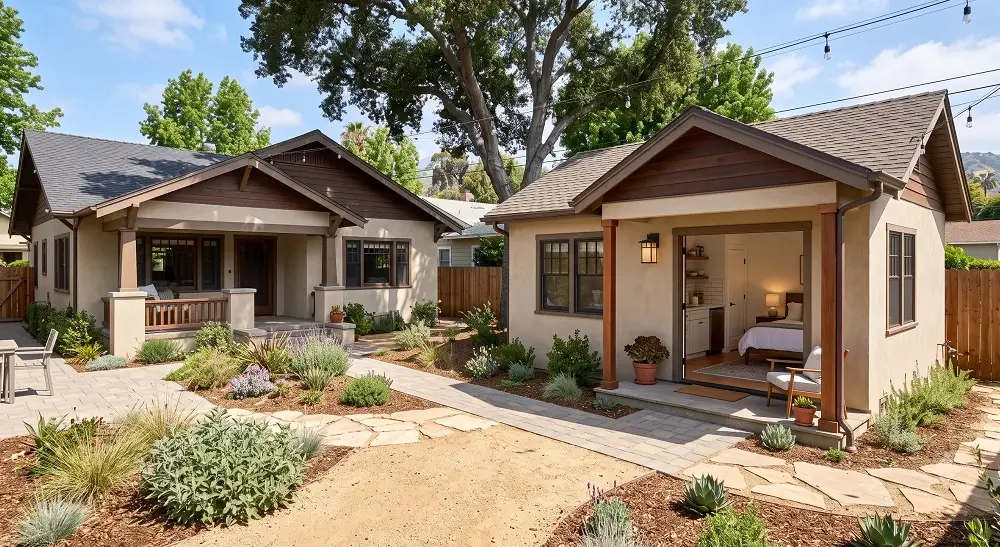
An attached ADU shares at least one wall with the primary residence. The maximum allowed size is either 1,200 square feet or 50 percent of the primary dwelling's square footage, whichever is smaller. Like detached units, attached ADUs require full living facilities and a separate entrance.
Garage Conversions
Converting an existing garage into a living space is one of the most common ADU approaches in Los Angeles. If you’re converting or demolishing a garage to build an ADU, neither LAMC 12.22 A.33 nor California state law requires you to replace the lost parking. This is an important distinction that removes a significant cost barrier for urban property owners with limited lot space.
Junior ADUs (JADUs)
A Junior ADU is a smaller unit, up to 500 square feet, created entirely within the walls of the existing primary residence. It must include an efficiency kitchen and either a private or shared bathroom. JADUs follow different ownership and rental rules than standard ADUs, so homeowners considering a rental property should understand those differences before planning a project. Our related analysis of California's new ADU law updates covers how AB 1154 recently revised JADU owner-occupancy requirements.
Movable Tiny Houses (MTHs)
Los Angeles also permits Movable Tiny Houses as a form of ADU through a ministerial process in residential zones. MTHs must meet ANSI A119.5 or NFPA 1192 standards and are subject to size, setback, and lot requirements consistent with other ADU types. They are restricted in the Very High Fire Hazard Severity Zone (VHFHSZ) hillside areas.
#cta_start
Unsure Which ADU Type Fits Your Property?
We assess your lot, your goals, and your budget — and tell you which unit type makes the most sense before a single line is drawn.
#cta_end
Los Angeles ADU Setback Requirements
Setback requirements often confuse homeowners and are a frequent source of plan check comments and revisions. For a deeper look at how setback rules work across California jurisdictions, our guide on ADU setback requirements covers the state-level framework that applies in Los Angeles County as well.
Standard Setbacks for Detached ADUs
Under both California state law and LAMC 12.22A.33, detached ADUs built on single-family lots are subject to the following baseline setbacks:
- Rear yard: 4 feet from the rear property line
- Side yard: 4 feet from the side property line
- Front yard: The standard front setback for the applicable zoning district — no reduction is available under ADU law
- Separation from primary dwelling: A minimum of 6 feet between the detached ADU and the main structure, which is a fire code requirement independent of property line setbacks.
These 4-foot rear and side setbacks are guaranteed under California Government Code Section 66342, which means local agencies cannot impose stricter setback requirements for ADUs that comply with these standards. State law overrides conflicting local setback standards in these situations, allowing homeowners to rely on the ADU-specific requirements instead of larger zoning setbacks.
Conversion ADU Setback Exemption
If you’re converting a legally established structure into an ADU, setback requirements do not apply to the existing footprint. The structure can be converted into an ADU without being moved closer to or farther from the property lines. This exemption makes garage conversions particularly attractive on smaller urban lots where setbacks would otherwise limit new construction options.

Hillside and Special Zone Properties
Properties in designated hillside areas fall under the Baseline Hillside Ordinance, which can impose additional setback requirements, reduced floor area ratios, and grading limits. On sloped lots, building height isn’t measured the same way it is on flat sites. For two-story hillside ADUs, understanding how height is calculated relative to the existing grade is essential. If your property is on a hillside, expect greater complexity during plan check. Confirming your zoning overlay through ZIMAS before starting the design phase is essential.
ADU Height Limits in Los Angeles
Height limits under the LA ADU ordinance vary based on the unit type and location.
For detached ADUs on single-family lots, the standard maximum height is 16 feet. Under state law updated by AB 2221, properties within half a mile of a public transit stop or on a lot with an existing two-story multifamily structure may qualify for an 18-foot height limit. Height limits don’t apply to conversions of existing structures — if you're converting a garage or other space, the existing roof height is generally preserved.
Attached ADUs may be built up to 25 feet in height when attached to the primary residence. Two-story ADUs are allowed under the ordinance, but what’s permitted on a specific property depends in part on the height district assigned to that lot. This is particularly relevant for lots with specific plan overlays or in neighborhoods subject to additional design review requirements.
ADU Parking Exemptions Under the Los Angeles Ordinance
Parking has historically been one of the biggest barriers to ADU development, and the current ordinance has significantly reduced this obstacle.
Under LAMC 12.22A.33 and state law, no parking replacement is required when an existing garage, carport, or covered parking structure is demolished or converted in connection with ADU construction. This removes the replacement parking requirement that previously made garage conversions impractical on many Los Angeles properties.
For newly constructed ADUs, parking may be required at a rate of up to one space per unit or per bedroom. However, parking is fully exempt when any of the following apply:
- The ADU is located within a half-mile walking distance of a public transit station
- The ADU is created through a conversion of an existing structure
- The property is in a designated historic district
- On-street parking permits are not required in the area, and the ADU is within one block of a car-share vehicle location.
In practice, a large share of properties in Los Angeles qualify for one or more of these exemptions given the city's transit network. Evaluating transit proximity during the feasibility stage allows the project team to determine whether parking requirements apply before design and budgeting begin.
Unit Count: How Many ADUs Can You Build in Los Angeles?
California Government Code Section 66314 guarantees that local agencies must allow at least one ADU and one JADU on any single-family residential lot, subject to ministerial approval. SB 543, effective January 1, 2026, further codified that local agencies must ministerially approve a combination of one attached ADU, one detached ADU, and one JADU on single-family lots.
For multifamily properties, SB 1211 allows up to eight new detached ADUs on lots with existing multifamily structures, capped at the number of existing residential units on the property. Existing non-habitable space in a multifamily building may also be converted into ADUs, with at least one conversion permitted and up to 25% of the existing residential unit count. These conversion rights are counted separately from the detached ADU allowance.
For a full breakdown of unit count rules by property type, our blog on how many ADUs you can build in San Diego covers the same state-level framework that applies throughout California, including Los Angeles County.
The LADBS Permit Process
All ADU permit applications in the city of Los Angeles go through the Los Angeles Department of Building and Safety. For qualifying projects, the review process is ministerial, meaning LADBS evaluates the application against objective code standards rather than discretionary criteria.
Under SB 543, which took effect January 1, 2026, local agencies now have 15 business days from the date an application is submitted to determine whether it is complete. If LADBS misses that deadline, the application is automatically deemed complete, and the 60-day final review clock begins. If LADBS then fails to approve or deny a complete application within 60 days, the permit is automatically approved.
This statutory framework makes the quality of the initial submittal more important than at any prior point. A complete, well-prepared application activates the clock in the homeowner's favor. An incomplete one restarts it and gives the reviewer an opening to request additional information.
What LADBS requires in a complete ADU submittal includes architectural plans with a full site plan, floor plans, elevations, and cross-sections; structural engineering documentation; California Title 24 energy compliance calculations; and clearances from any applicable departments, such as the Bureau of Engineering, for sewer connections on projects over 500 square feet.
Coastal Zone Properties in Los Angeles
A portion of Los Angeles lies within the California Coastal Zone, including areas such as Venice, Pacific Palisades, and portions of San Pedro and Wilmington. Properties in these areas have historically required a Coastal Development Permit in addition to the standard LADBS building permit, and coastal permitting operated without any statutory deadline.
AB 462, effective January 1, 2026, changed this. The City of Los Angeles, which has a certified Local Coastal Program, is now required to approve or deny a Coastal Development Permit within 60 days of receiving a complete application. Instead of waiting for one review to finish before the next begins, both reviews move forward at the same time. For homeowners in Venice, Pacific Palisades, and other coastal areas, this makes project scheduling more predictable.
Common Reasons ADU Applications Get Corrections in Los Angeles
Understanding the LA ADU ordinance is less important if the documentation submitted to LADBS doesn't reflect it accurately. The most common reasons applications receive correction letters include incomplete coordination between the architectural drawings and the structural engineering pages, Title 24 energy documentation that doesn't match the building design, setback calculations that apply the wrong standard (zone setback versus ADU setback), missing utility connection details for projects over 500 square feet, and height calculations that don't account for the correct grade measurement methodology for the specific lot.
Each correction letter restarts a portion of the review cycle. For homeowners learning how to get a building permit, understanding these common pitfalls helps frame what a quality plan set must accomplish before it's submitted.
What Makes a Los Angeles ADU Application Approvable on First Submission?
A complete, first-submission-ready ADU application for LADBS requires more than a set of architectural drawings. The full package must include internally consistent architectural and structural documentation, a Title 24 energy report reflective of building design, accurate site plan dimensions that reflect current setback measurements, clearance documentation for applicable city departments, and a solar panel design that meets Title 24 requirements for newly constructed detached ADUs.
Experienced ADU permitting firms know what LADBS reviewers expect, which agencies need to sign off on different projects, and how to assemble a complete application from the start. This reduces the correction cycles that extend timelines and add carrying costs for property owners.
Moving Forward with Your Los Angeles ADU Project
The Los Angeles ADU ordinance provides property owners a clear approval pathway, and SB 543 now holds LADBS accountable to strict review deadlines. A complete, well-prepared submittal is your most effective tool for keeping your project on schedule. Contact us today for a free consultation.