California homeowners are adding accessory dwelling units at record rates, but rental income potential continues to be the critical factor in deciding whether to build. Many property owners struggle to estimate what an ADU can actually earn, how different rental strategies compare, and whether the investment will generate positive cash flow after financing costs.
Professional San Diego ADU design & permitting services can help you maximize your property's earning potential while navigating local regulations. Our team at Streamline Design & Permitting has put together this guide to break down real rental income numbers, financing strategies, and the calculations you need to evaluate whether an ADU makes financial sense for your California property.
How Much Income Can an ADU Generate?

Monthly rental income from accessory dwelling units varies significantly based on location, size, and rental strategy. San Diego homeowners typically earn $1,800 to $3,500 per month from long-term ADU rentals, while Los Angeles properties command $2,200 to $4,200 monthly in high-demand neighborhoods.
Factors That Determine ADU Rental Income
- Property location within the city matters most. Coastal San Diego properties with beach access consistently generate 30-40% higher rental income than inland locations. Properties near universities, hospitals, or major employment centers typically command premium rates due to housing demand from professionals and graduate students.
- Unit size and design features directly impact pricing. Studio ADUs (400-600 sq. ft.) rent for $1,500-$2,400 per month, while two-bedroom units (800-1,200 sq. ft.) earn $2,800-$4,500. Modern finishes, in-unit laundry, dedicated parking, and private outdoor space can justify rent premiums of 15-25% in competitive markets.
- Local zoning regulations affect rental options. Some California cities restrict short-term rentals or require owner-occupancy of either the main house or the ADU. San Diego, for example, limits short-term rentals in certain zones, which directly impacts whether you can pursue vacation rental strategies.
A Comparison of Long-Term vs. Short-Term Rental Income
Long-term rentals provide stable monthly cash flow with minimal management demands. Tenants typically sign 12-month leases, which creates predictable income and lower turnover costs. Property owners avoid frequent cleaning, restocking supplies, or managing guest communications.
Short-term vacation rentals through platforms generate higher gross income but involve substantially more operational work. San Diego ADUs can earn $150-$300 per night during peak season, potentially generating $3,500-$6,000 monthly in the summer. However, off-season vacancy rates, cleaning costs, platform fees (typically 15-20%), and increased maintenance reduce net income significantly.
Key considerations for short-term rental strategy:
- Legal compliance: Many California cities require permits, impose occupancy taxes, and limit rental days per year. Some neighborhoods prohibit short-term rentals entirely.
- Operational costs: Professional cleaning between guests ($75-$150 per turnover), restocking consumables, and time spent on guest communication add up quickly.
- Vacancy risk: Seasonal demand fluctuations mean 30-40% vacancy rates during off-peak months in many California markets.
- Insurance requirements: Short-term rentals require specialized liability coverage, typically costing $1,000-$2,000 annually beyond standard landlord policies.
Most San Diego homeowners find long-term rentals provide better risk-adjusted returns with significantly less time investment. Having a stable tenant is a model that works particularly well for property owners maintaining full-time jobs or managing multiple properties.
When ADU Income Becomes Profitable

Over time, cash flows improve significantly as rents increase while mortgage payments remain fixed. Using the same San Diego example with 3% annual rent increases, the property reaches break-even cash flow in year 4 and generates $6,200 positive annual cash flow by year 7.
Refinancing or paying off the construction loan accelerates profitability dramatically. For example, property owners who refinance after 5 years typically reduce monthly payments by $400-$700, immediately improving cash flow. Those who finance through ADU permit cost considerations and construction budgeting find more favorable terms that lead to faster payback periods.
How Does ADU Income Affect Mortgage or Refinancing?
Recent changes to Fannie Mae guidelines now allow borrowers to use projected rental income from accessory dwelling units when qualifying for mortgages or refinancing. This policy shift opens financing opportunities for homeowners who couldn't qualify previously based solely on employment income.
Using ADU Rental Income for Loan Qualification
Lenders can count up to 30% of the borrower's total qualifying income from an existing or proposed ADU on their primary residence. The property must remain owner-occupied, meaning homeowners must live in either the main house or the ADU while renting the other unit.
Requirements for using ADU rental income include a completed appraisal showing the ADU's market rent potential, documented rental agreements if the unit is already occupied, and standard debt-to-income ratio calculations. Borrowers cannot claim rental income from multiple ADUs on the same property for qualification purposes.
This financing advantage makes ADUs more accessible for California homeowners. A family earning $120,000 annually can potentially add $36,000 in projected ADU rental income (with 30% cap = $10,800 counted), significantly improving debt-to-income ratios and loan approval odds.
Because of these rental income provisions, any San Diego properties with garage ADU conversions or attached ADU configurations now qualify for better refinancing terms.
Cost to Build an ADU
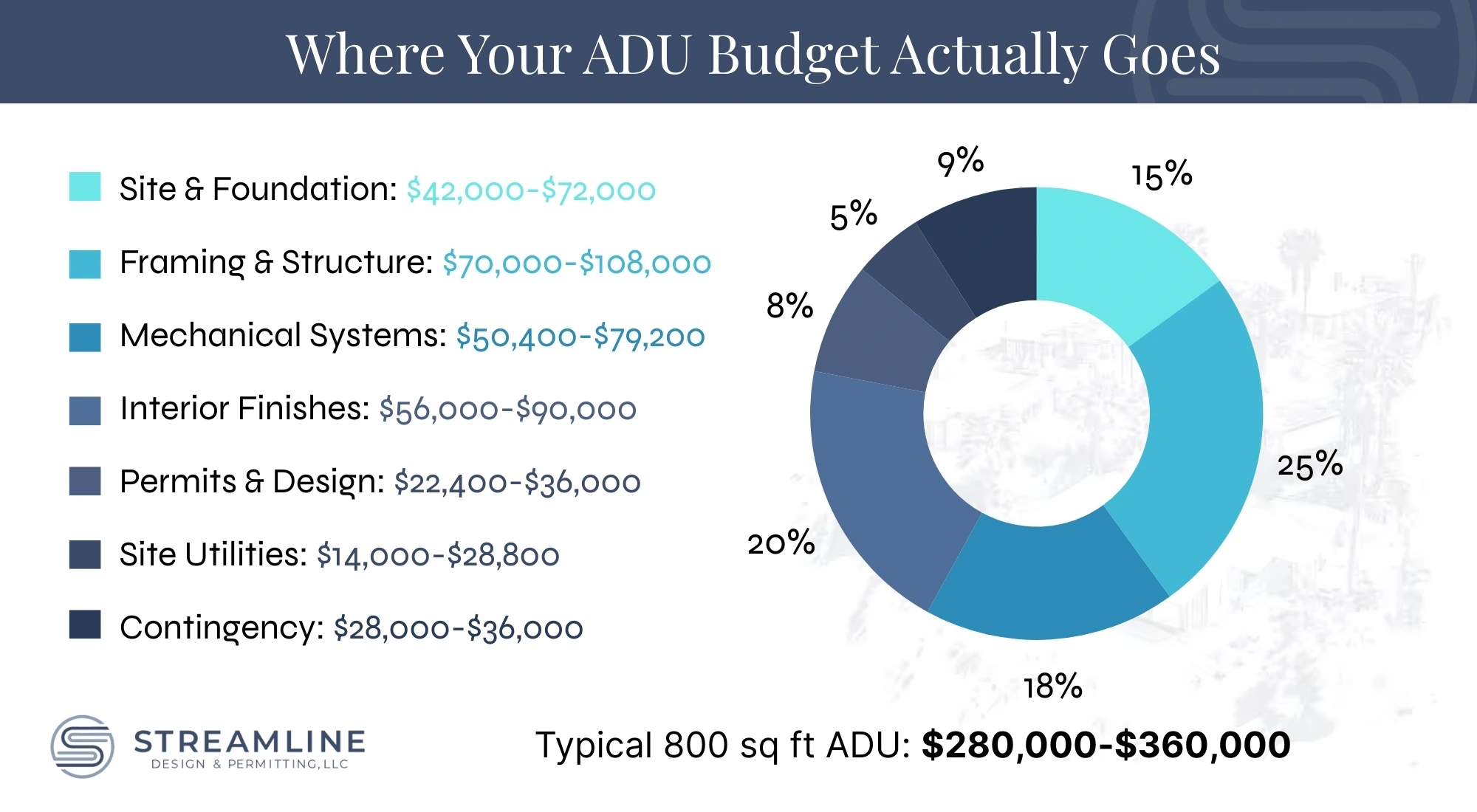
Construction costs are typically the largest barrier to ADU development, with California homeowners spending $200,000 to $500,000, depending on size, site conditions, and finish quality. Financing this investment requires careful evaluation of available options and their long-term impact on property value and cash flow.
- Site preparation and permits: Development costs start before construction begins. Permit fees in San Diego typically range from $8,000 to $15,000, while utility connections add $5,000 to $20,000, depending on the existing infrastructure. Properties that need significant grading, demolition, or setback compliance face additional costs.
- Construction and materials: Building costs average $250-$400 per square foot in California metropolitan areas. A 600-square-foot studio ADU costs $150,000-$240,000, while a 1,000-square-foot two-bedroom unit runs $250,000-$400,000. These figures include foundation, framing, mechanical systems, appliances, and interior finishes.
- Soft costs and contingency: Design fees, engineering consultations, insurance during construction, and project management typically add 15-20% to hard construction costs. This is why we recommend budgeting an additional 10-15% contingency for unforeseen site conditions or permit requirement changes.
The growth in California ADUs has prompted more lenders to develop specialized financing products, improving options for homeowners without substantial existing equity.
Tax Benefits and Deductions for ADU Rental Income
Rental income from accessory dwelling units creates various tax obligations, but property owners can offset earnings through legitimate business deductions. California homeowners must report all rental income on Schedule E of their federal tax return, but tracking expenses properly can significantly reduce taxable income.
Common ADU Tax Deductions
Mortgage interest on loans used to construct or improve the ADU remains fully deductible against rental income. Property owners financing a $250,000 ADU at 7.5% can deduct approximately $18,750 in interest during the first year, substantially reducing taxable rental income.
Operating expenses eligible for deduction include:
- Property taxes: The additional property tax assessment from the ADU's added value (typically 1.2-1.5% of construction cost in California) qualifies as a rental expense deduction.
- Insurance premiums: Landlord liability coverage, additional dwelling coverage, and loss-of-rent insurance all qualify for a full deduction.
- Repairs and maintenance: Ongoing costs like painting, plumbing repairs, appliance fixes, and pest control services remain fully deductible in the year incurred.
- Utilities: When the landlord pays utilities, 100% of ADU costs qualify as business expenses.
Depreciation is the most significant non-cash deduction for ADU owners. The IRS allows residential rental properties to depreciate over 27.5 years, meaning a $300,000 ADU generates approximately $10,909 in annual depreciation deductions regardless of the actual changes in property value.
California homeowners should note that ADU tax credits and state-specific incentives may provide additional benefits, though most programs focus on affordable housing commitments rather than market-rate rentals.
Managing Tax Obligations for Short-Term Rentals
Properties rented for less than 15 days annually qualify for a special tax exemption. Income from these short-term rentals remains tax-free, and owners cannot deduct expenses. This provision benefits homeowners renting ADUs only during peak vacation seasons or major local events.
Short-term rentals exceeding 14 days require tracking additional expenses. Cleaning costs between guests, platform fees (Airbnb, VRBO), guest supplies, and increased maintenance all qualify as deductible business expenses. Property owners must also collect and remit transient occupancy taxes in most California cities, making things more complex.
This is where professional tax consultation becomes valuable for ADU owners, especially those pursuing short-term rental strategies or operating multiple rental units. The combination of depreciation, expense tracking, and passive income rules creates complexity beyond typical homeowner tax situations.
Maximizing ADU Rental Value

Property features and management decisions significantly impact rental income and tenant quality. Strategic investments in specific amenities generate measurably higher rents while reducing vacancy periods and maintenance calls.
High-Impact Features That Boost Rental Income
Having dedicated, on-site parking adds 10-15% to achievable rent in California markets where street parking remains limited. San Diego properties with covered parking or garage spaces for the ADU consistently rent faster and command premium rates compared to units requiring tenants to park on the street.
Modern kitchen and bathroom finishes are another easy way to justify higher rents and attract quality tenants. Quartz countertops, stainless steel appliances, and updated fixtures signal property owners invested in quality, typically returning 150-200% of upgrade costs through higher rents over 5 years.
Here are some additional features that improve rental appeal:
- In-unit laundry: Full-size washer and dryer increase rent by $100-$200 monthly and dramatically reduce vacancy time. Properties without laundry facilities face longer tenant searches, particularly for family renters.
- Energy-efficient systems: LED lighting, programmable thermostats, and modern insulation reduce tenant utility costs while demonstrating environmental responsibility. These features are especially appealing to young professionals and eco-conscious renters.
- Private outdoor space: Fenced patios, small yards, or dedicated deck areas increase desirability, especially in urban markets where outdoor space is limited. Even 100-200 square feet of private outdoor area can justify monthly rent increases of $150-$250.
- Climate control: Central air conditioning in warm California climates or efficient heating systems in coastal areas directly impact tenant comfort and reduce move-out frequency.
Property Management Considerations

Self-management is a money-saving strategy, but it requires time investment for tenant screening, lease administration, maintenance coordination, and rent collection. Most California homeowners choose self-management for single ADU rentals, particularly when tenants are extended family members or when the landlord lives on the same property.
Professional property management costs 8-12% of monthly rent but provides complete tenant management, maintenance coordination, and legal compliance oversight. This option is ideal for property owners with demanding careers, multiple rental units, or properties located far from their primary residence.
Tenant screening quality is a huge facet in rental income success. Thorough background checks, income verification (typically 3x monthly rent), rental history reviews, and credit reports significantly reduce problem tenancies and payment defaults.
Lease agreements should clearly specify maintenance responsibilities, utility payment obligations, parking arrangements, and policies regarding pets, smoking, and additional occupants. California landlord-tenant law provides specific requirements for security deposits, notice periods, and eviction procedures that property owners must understand.
If you need more guidance, you don’t have to navigate this alone. The recent growth in California ADUs has created more resources for property owners, including specialized landlord associations and ADU-specific property management companies.
Start Building Your ADU Rental Income Stream with Us
California accessory dwelling units generate measurable rental income while building long-term property value, but success isn’t guaranteed. In reality, it requires realistic financial projections, proper construction financing, and thoughtful rental strategy decisions. Properties with strong rental income potential typically combine favorable locations, quality construction, and financing structures that allow positive cash flow within 3-5 years.
Streamline Design & Permitting specializes in San Diego ADU design & permitting services, helping property owners navigate zoning requirements, optimize rental income potential, and complete projects that generate strong investment returns. From concept to approval, we’ll be here to guide you every step of the way. Contact us today for a comprehensive site evaluation and customized financial analysis showing your property's specific rental income potential.