Choosing between an attached and detached accessory dwelling unit (ADU) can determine whether your project stays within budget, maximizes rental income, or triggers unexpected code upgrades. The wrong choice means wasted design fees, extended permit timelines, and construction costs that spiral beyond your original estimate.
This is why San Diego homeowners benefit from working with experienced San Diego ADU design services that can assess lot constraints, zoning limitations, and budget realities before committing to either attached or detached configurations.
At Streamline Design & Permitting, we’ve provided a comparison that breaks down ADU cost differences, permit requirements, privacy implications, and property value impacts to help you select the ADU type that aligns with your goals.
Attached ADU: Building Connected to Your Primary Residence
Attached accessory dwelling units connect to your existing home through at least one wall, sharing structural elements and utility systems. These units convert existing or proposed space, including garage conversions, second-story additions, or main house extensions.
The Cost for Attached ADUs
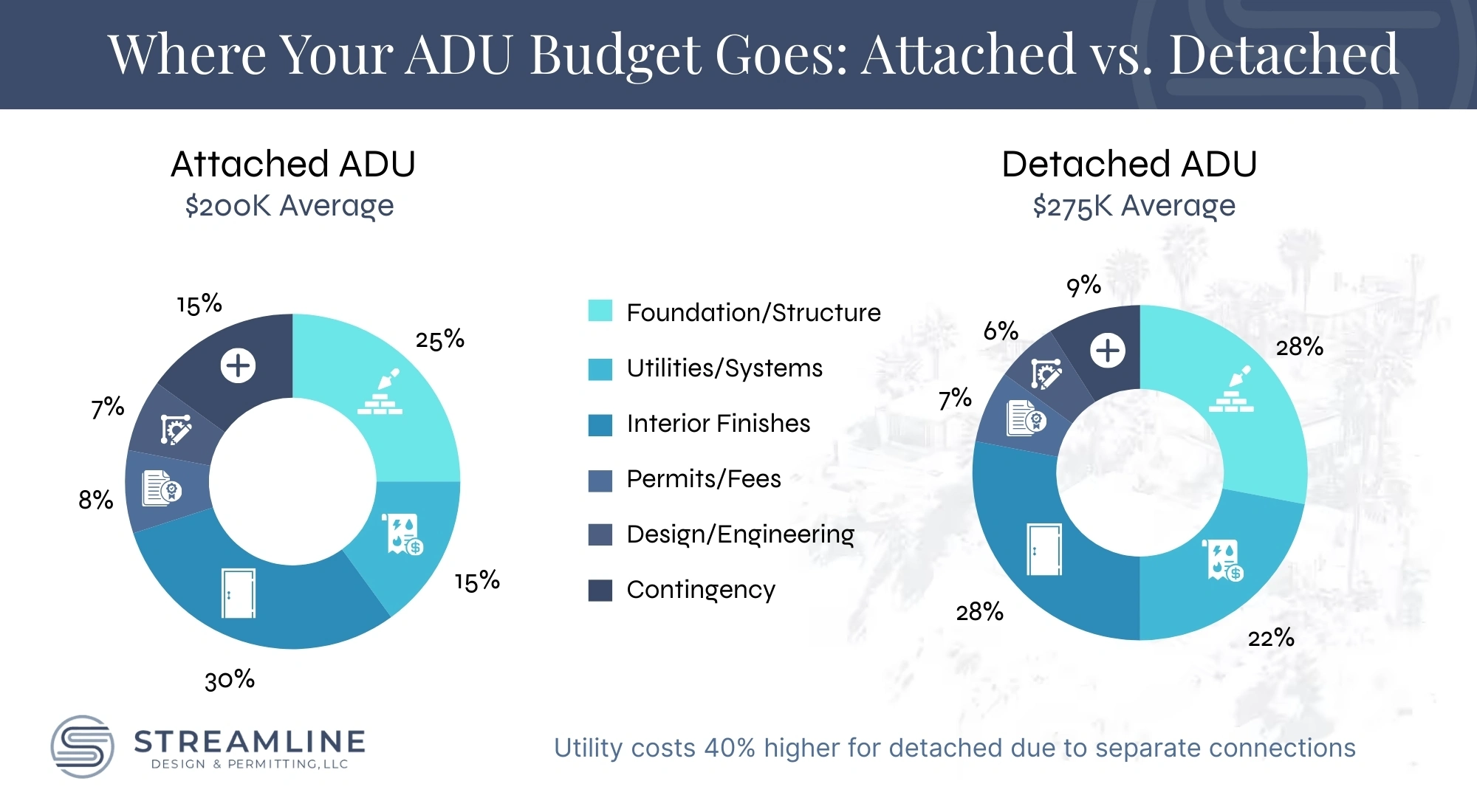
Attached units leverage existing infrastructure, reducing expenses through shared walls, roofing, and utilities. Budgets range from $150,000–$250,000, depending on the project’s complexity and conditions.
Construction cost breakdown:
- Garage conversions: $120,000–$180,000 for projects converting garage space into living areas. Garage conversion costs include foundation modifications, utility upgrades, and finishes while utilizing existing walls and roofing.
- Second-story additions: $180,000–$250,000 for ADUs above attached garages requiring structural reinforcement and separate access. These additions demand engineering analysis and often trigger additional code requirements.
- Junior ADUs: $80,000–$120,000 for units that are 400–500 square feet with efficiency kitchens and shared sanitation facilities. These qualify for streamlined permitting but limit rental income due to size restrictions.
Fire sprinkler retrofits cost $8,000–$15,000 when triggering whole-house compliance for pre-2011 properties. Energy code upgrades add 15–20% to estimates when substantial alterations impact the existing structure.
Permitting and Regulatory Requirements
Attached projects face complex permits because modifications trigger code compliance reviews for the whole property. San Diego jurisdictions require fire sprinklers throughout pre-2011 properties when adding substantial square footage.
According to California state law, attached ADUs must meet current energy codes. This often forces homeowners to upgrade insulation, windows, and HVAC in the primary residence. As a result, costs are added, and timelines can extend by 4–8 weeks.
ADU permit costs in San Diego include plan check fees of $2,000–$4,000 and impact fees of $8,000–$15,000, depending on jurisdiction. Coastal properties require Commission review, adding 2–4 months. Second-story additions need engineering review, with revision cycles extending timelines.
Utility Connections and Infrastructure
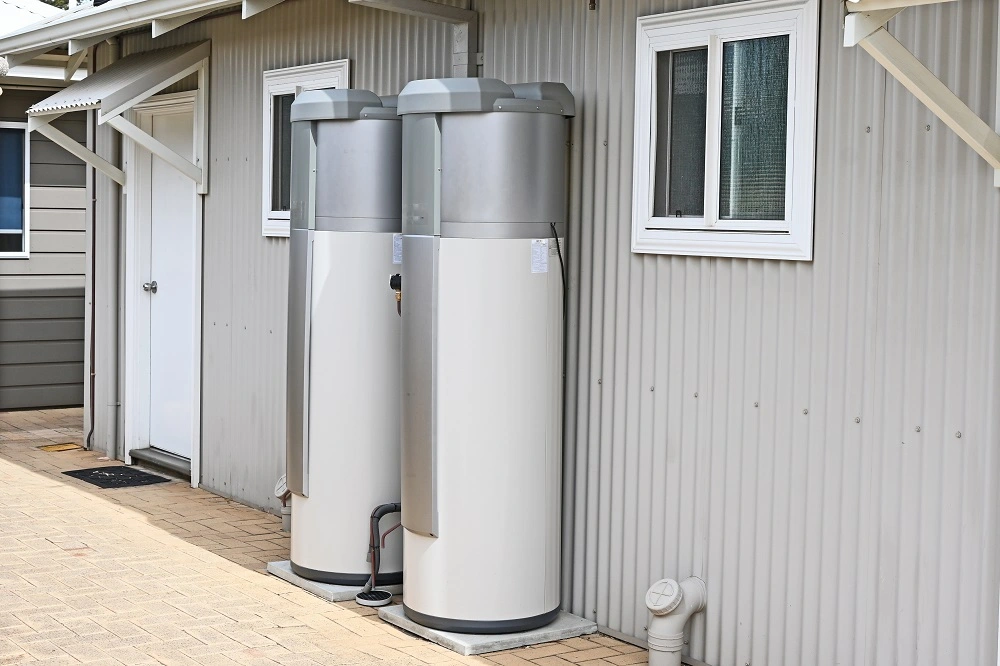
Attached units share sanitation and utility infrastructure with the primary residence, reducing costs to $5,000–$12,000 for upgrades and fixtures. These connect to existing water heaters, electrical panels, and HVAC equipment.
Shared system implications:
- Electrical service: Panels often require 100–200-amp upgrades costing $2,000–$4,000. Properties with older 100-amp services need complete replacements.
- Water heating: Standard 40–50-gallon heaters struggle to serve both units. Tankless upgrades cost $2,500–$4,500 but provide unlimited capacity.
- HVAC systems: Existing systems cannot condition additional square footage. Separate mini-splits cost $3,500–$6,000, providing independent control.
Property owners pay all utility bills for shared systems, which reduces net rental income by $150–$250 per month. California mandates solar panels, with systems sometimes integrating into existing arrays to reduce costs.
Construction Timeline and Process
Attached projects start with structural modifications, including wall removal, foundation reinforcement, or removing garage doors. Initial phases take 6–10 weeks, followed by framing and finishes. In total, the project can take a total of 20–32 weeks.
Construction averages 8–14 months from permit approval to final inspection. Contractors discover outdated wiring, plumbing, or structural issues requiring remediation, adding 2–6 weeks and 10–15% unexpected costs. Retroactive building permits may be needed when revealing unpermitted work.
In San Diego County, permit approval takes 3–6 months, with revision cycles adding weeks. Working with experienced design professionals reduces delays by submitting complete applications.
Detached ADU: Standalone Structure on Your Property
Detached accessory dwelling units function as separate structures that need independent foundations and utility connections. These units stand apart from your primary residence, offering design flexibility and privacy advantages.
Cost Analysis for Detached ADUs
Detached structures demand complete independent construction, including foundations, roofing, utility trenching, and separate permits. Budgets range from $200,000–$350,000, depending on size, finishes, and site conditions.
Construction cost breakdown:
- One-bedroom detached units: $200,000–$280,000 for 600–850-square foot structures with standard finishes. These include complete foundations, framing, roofing, and utility connections.
- Two-bedroom detached ADUs: $250,000–$350,000 for 900–1,200-square-foot units with separate bedroom wings. Additional square footage increases costs while maintaining reasonable per-square-foot pricing.
- Converted detached garages: $150,000–$220,000 when transforming existing structures. These reduce costs by utilizing existing foundations and walls while avoiding the complexity that comes with site preparation.
You can expect to add $15,000–$25,000 for utility connection expenses, like trenching water, sewer, electrical, and gas lines. Strategic placement near existing corridors minimizes costs, while service upgrades face $5,000–$12,000 in capacity improvements.
Lifestyle and Privacy Considerations
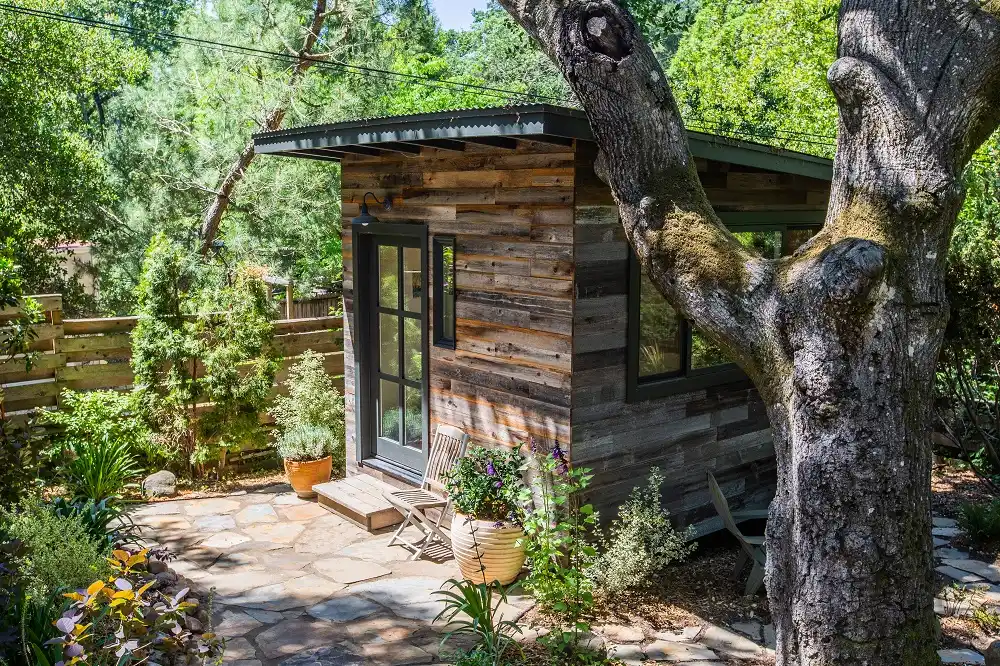
Detached structures eliminate shared wall concerns, offering complete acoustic separation. Tenants and family members operate independently without disturbing occupants in the main house.
Privacy advantages:
- Independent access: Detached units use separate entrances and pathways, reducing conflicts over guest policies and schedules.
- Yard separation: Strategic placement creates distinct outdoor zones. To further define boundaries, property owners can install privacy fencing.
- Utility independence: Separate metering allows tenants to control thermostats and consumption. This autonomy simplifies landlord-tenant relationships.
Detached configurations are ideal for long-term rental strategies where tenant turnover requires professional dynamics. Having a physical separation establishes clear boundaries protecting the privacy of both parties.
Permitting and Regulatory Requirements
Detached units process as separate structures, avoiding primary dwelling code triggers and simplifying permits. These must comply with setback requirements in San Diego, typically 4 feet from side yards and 5 feet from rear boundaries.
According to California regulations, detached structures under 800 square feet qualify for expedited review, reducing timelines to 60–90 days compared to 3–6 months. Building departments prioritize these under state-mandated requirements.
Solar mandates require 2–4 kW systems, depending on square footage. California ADU tax credits offset installation costs, reducing solar compliance expenses. Parking requirements remain waived under state law.
Utility Connections and Infrastructure
Detached structures must have separate utilities from the property's main connections, with costs varying by distance. Tenants can pay their own bills when there’s separate metering, increasing net rental income by $150–$300 monthly.
Independent system requirements:
- Electrical service: Detached units need dedicated panels that require trenching. Underground conduit costs $8–$15 per linear foot, with total expenses of $8,000–$15,000.
- Water and sewer: Connecting to main lines requires trenching costing $6,000–$12,000 for typical 50–100-foot runs. Inadequate capacity needs upgrades, adding $3,000–$8,000.
- Gas service: Natural gas connections cost $2,000–$4,000. Some elect all-electric designs to avoid trenching costs.
Solar installations require standalone systems typically costing $6,000–$12,000 after tax incentives. These ensure code compliance while reducing long-term operating costs.
Construction Timeline and Process
Detached units follow predictable sequences, starting with site preparation and utility trenching during the first 4–8 weeks. Structural framing takes 6–10 weeks, followed by rough utilities and finishes that require 24–36 weeks.
On average, construction takes 10–18 months from permit approval to occupancy, with prefabricated designs reducing timelines by 2–4 months. Weather can impact the initial site work, but once framing is finished, enclosed structures progress consistently.
Detached projects avoid existing home surprises, following standardized schedules that contractors predict accurately. Site-specific challenges occasionally extend timelines, but these problems typically come to light during planning rather than mid-construction.
Attached vs. Detached ADU: Direct Comparison
Let’s now examine attached vs. detached ADUs head-on. Understanding the specific differences between attached and detached accessory dwelling units helps San Diego homeowners make informed decisions based on their property constraints, budget parameters, and long-term investment goals.
The $50,000-$100,000 price difference between attached and detached options is driven by the underlying construction, not by differences in finishes. Detached structures need complete foundations, independent roofing systems, and separate utility infrastructure that attached units share with existing homes. This investment generates higher rental income that averages $400–$700 per month, helping property owners recover the additional construction expense within 8–12 years.
How to Choose Between Attached and Detached ADUs
Selecting the right type of ADU requires evaluating multiple property-specific factors, financial situation, and intended use. Here are some parameters to consider:
- Budget and financing capacity: Choose attached ADUs for budgets around $150,000–$200,000 to leverage existing structures, while detached options are feasible for projects exceeding $200,000 if lot geometry and utility costs allow.
- Lot dimensions and available space: Attached units are often the only option for lots with less than 40 feet of rear yard depth, but existing detached garages offer conversion opportunities that are 20–35% less than new construction.
- Intended occupancy duration: Attached units are cost-effective for shorter-term housing (3–7 years) for families, whereas long-term rental income strategies favor detached ADUs due to enhanced privacy and stronger returns.
- Privacy and lifestyle priorities: Attached units are ideal for homeowners who are comfortable with shared walls and tenant interaction, while detached structures eliminate noise concerns and create distinct living territories for maximum boundary and privacy.
- Timeline urgency and flexibility: Attached configurations may offer faster permit processing and are suited for projects needing completion within 12 months, but detached units progress more predictably, making them better for flexible occupancy schedules.
- Property value and resale considerations: Detached ADUs generally maximize resale returns, increasing property values by 15–20%, compared to the 10–15% value increase provided by lower-cost attached units.
- Risk tolerance for code compliance issues: Attached projects risk triggering costly mandates (e.g., fire sprinklers, energy retrofits) on the main house, making detached alternatives ideal for property owners who want more cost certainty.
Ready to Design Your Perfect ADU?
Choosing between attached and detached ADUs impacts your budget, property value, rental income potential, and construction timeline in ways that affect every stage of your project. San Diego homeowners who evaluate their lot constraints, privacy needs, and long-term goals before committing to either configuration avoid costly design revisions and maximize their ADU investment returns.
Streamline Design & Permitting's seasoned team brings over 25 years of San Diego ADU expertise, helping property owners navigate zoning restrictions, building codes, and design trade-offs to select the attached or detached configuration that aligns with their specific property and goals. Contact us today for a site evaluation.