Tiny homes have moved from the fringe to a legitimate part of the housing conversation. With construction costs lower than a traditional ADU in San Diego and a growing number of local permitting pathways, they attract homeowners who want to add livable space without a full-scale build. However, finances are also an important consideration: will a tiny home hold its value, gain it, or quietly lose it over time?
The answer depends less on the structure itself and more on a single underlying factor — your relationship to the land beneath it.
Two Very Different Structures, Two Very Different Outcomes

When people search for tiny homes as a housing option, they are typically looking at one of two things: a structure built on a wheeled trailer frame (called a Tiny House on Wheels, or THOW), or a small permanent dwelling built on a foundation. From the outside, these two formats look similar, but financially, they behave almost nothing alike.
Real estate appreciates primarily because land appreciates. A well-built house on its own typically loses value to age, wear, and obsolescence. What offsets that decline, in traditional homeownership, is the rising value of the ground beneath it. Pull the land out of the equation, and appreciation becomes a much harder case to make.
A THOW places a homeowner in that exact position. The structure sits on someone else's land, or leased space, or a family member's lot, without formal title arrangements. The land value accumulates for whoever holds the deed, and the THOW owner holds a depreciating asset.
Tiny Homes on Wheels: Understanding the Depreciation Reality
In California, THOWs are classified as recreational vehicles, and that classification shapes how they’re handled in nearly every financial transaction.
.webp)
Mortgage financing isn’t available for a THOW. Buyers rely on personal loans or RV-style financing, both of which carry higher interest rates, shorter repayment terms, and stricter qualification requirements than a standard home loan. A smaller pool of buyers combined with more limited financing options can make resale more challenging, and pricing often reflects that reality.
The structure itself ages like a vehicle. The trailer frame, axles, and undercarriage depreciate on a predictable curve regardless of how well the living space above is maintained. Lenders, appraisers, and buyers account for this.
None of this makes a THOW an unreasonable housing choice. For a homeowner whose goals are flexibility, lower entry cost, or temporary additional space, the math may still work. However, for those with a primary goal of adding long-term equity to a property, a wheeled structure is the wrong tool.
The San Diego County Picture for THOWs
.webp)
San Diego County took a notable step in late 2025. The Department of Planning and Development Services issued a determination that THOWs meeting specific construction and safety standards can be recognized as dwellings under the County's existing Zoning Ordinance in unincorporated areas. In other words, a qualified THOW can be permitted as a primary residence or as an ADU alongside an existing home.
To qualify, a THOW must be certified to ANSI A119.5 standards, meet applicable fire safety and insulation requirements, be limited to one story and under 430 square feet, and be connected to utilities. A building permit is required before permanent habitation. If the THOW is later removed from the property, a demolition permit must be filed.
This is an important development for homeowners in unincorporated San Diego County who are considering a THOW as a second unit. It removes the ambiguity that previously made planning around these structures difficult.
However, the City of San Diego has different rules. The City does not recognize THOWs the way unincorporated County areas now do. Homeowners in incorporated municipalities should verify the applicable local standards before making any commitments.
Foundation-Built ADUs: Where Appreciation Becomes Realistic
A small dwelling built on a permanent foundation and permitted as an ADU operates as real property. It appears on the title, can be appraised, can be financed through the equity in the parent property, and is marketable to conventional buyers. The land appreciation component is present and working for you.
Permitted ADUs in San Diego County also carry legal rental status under California law. Units must be rented for periods longer than 30 days. A legally rentable unit that adds recognized square footage, has its own address, and is properly recorded on title can contribute to property value in ways that an unpermitted structure—or a THOW placed informally—cannot.
One widely cited rule of thumb: a permitted ADU may add to the overall property value at a multiplier of roughly 100 times its achievable monthly rent. For example, a unit renting for $2,500 per month in a San Diego market would, under that framework, represent approximately $250,000 in added property value.
Local conditions and specific property characteristics affect this significantly, and an appraisal is the only reliable way to confirm the number for a given property. But the directional relationship is consistent: a permitted, rentable ADU adds documented value. An unpermitted or unrecorded structure does not.
Under California's Proposition 13, adding an ADU triggers a reassessment only on the value of the new construction. The assessed value of the existing primary dwelling isn’t impacted. The ADU's value is added as a supplemental assessment. It’s ideal for homeowners to get a projected tax impact estimate as part of pre-construction planning.
Installation and Cost Considerations
Whether the choice is a THOW or a foundation-built ADU, several site-specific factors determine the project’s costs and feasibility.
Utility Connections
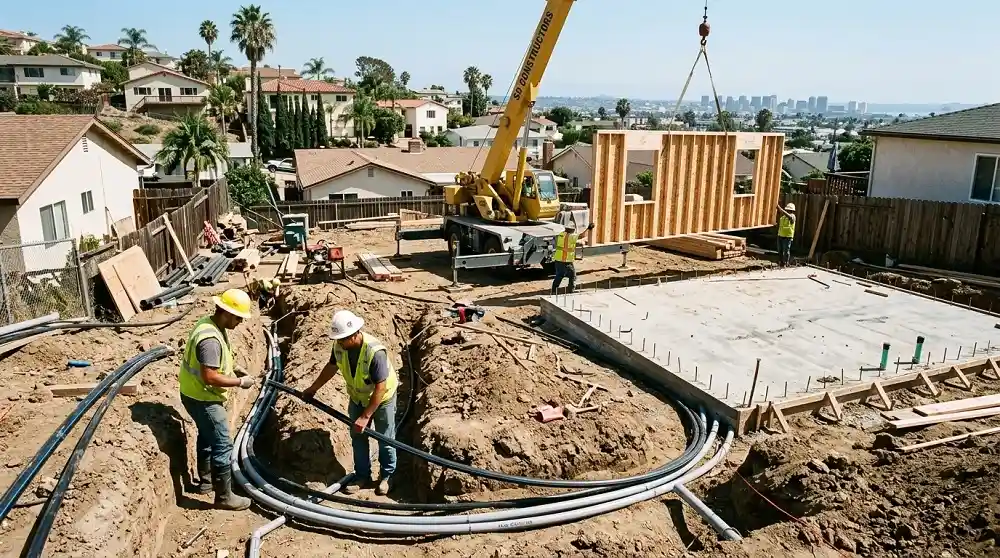
A permitted dwelling of any type requires water, sewer, and electrical service. In San Diego County, SDG&E requires a separate electric meter for new ADUs. The distance from existing utility lines to the proposed unit location is one of the largest drivers of soft cost variation from property to property.
Site Conditions
Slope, soil composition, and existing drainage patterns impact the level of site preparation that’s needed before construction starts. A flat, accessible lot with utilities nearby is materially less expensive to develop than one with grade changes, poor soil, or constrained access.
Setbacks
California Government Code Sections 66310 through 66342 limit rear and side setbacks for ADUs to a maximum of four feet. Local jurisdictions apply their own standards within that framework. For THOWs permitted as ADUs under the County determination, the same setback logic applies. The buildable area of a lot is shaped by setback requirements, lot dimensions, and any existing structures already on the property.
Zoning Overlays
Fire hazard severity zone designations, historic district boundaries, and other overlay conditions apply to certain properties in San Diego County and can affect both what can be built and how it must be built. These must be identified at the beginning of the process, not after design work has started.
Pre-Construction Steps for a Tiny Home or ADU Project
For homeowners still weighing a THOW against a foundation-built ADU, the pre-construction phase is where that decision becomes informed rather than arbitrary.
.webp)
1. Establish Your Property's Regulatory Context
Determine whether the property is in unincorporated San Diego County, within an incorporated city, or subject to any overlays that would affect the project.
2. Assess the Site
Evaluate buildable area, setbacks, utility access, slope, and any site conditions that would impact cost before any design work is commissioned.
3. Clarify Your Financial Goals
If long-term property appreciation matters, a permitted foundation-built ADU is the more reliable path. If flexibility and lower entry cost are the priority, a THOW permitted under current County standards may be worth exploring with a clear understanding of its value limitations.
4. Determine the Right Unit Type
The combination of site constraints, goals, and budget should drive the structure decision, not the other way around.
5. Prepare the Permit Package
Whether for a THOW or a conventional ADU, a complete permit submission includes site plans, architectural drawings, Title 24 energy compliance documentation, and any engineering needed for the specific site.
Making the Decision
The tiny home market is growing, and regulatory barriers in San Diego County have dropped meaningfully. While this context is useful, the investment question deserves a direct answer: foundation-built ADUs in San Diego County have a track record of adding property value and generating rental income. THOWs can be placed legally in unincorporated areas under current County standards, but they depreciate and carry financing constraints that limit their long-term value contribution.
Homeowners who understand those differences before committing to a design are generally better positioned for a smoother, more predictable project process.
At Streamline Design & Permitting, we work with homeowners across San Diego County through the pre-construction decisions that determine how a project turns out: what a property can support, what the permitting process requires, and how to move forward without avoidable setbacks. If you’re weighing a tiny home or an ADU addition, we’re here to help you understand your property’s specific picture. Book a consultation to discuss your property.


.webp)