California's ADU rules have changed more in the past two years than in any prior period, and 2026 brings additional refinements. For San Diego County homeowners, this means more options, clearer approval pathways, and fewer opportunities for local agencies to delay a project.
However, the number of ADUs that can actually be built on a specific property is never determined by state law alone. Property type, jurisdiction, and site conditions all shape the realistic answer, which is why many homeowners start with ADU design and permitting in San Diego before moving into formal plans.
This guide reflects the rules as they stand in 2026.
What State Law Guarantees on a Single-Family Lot
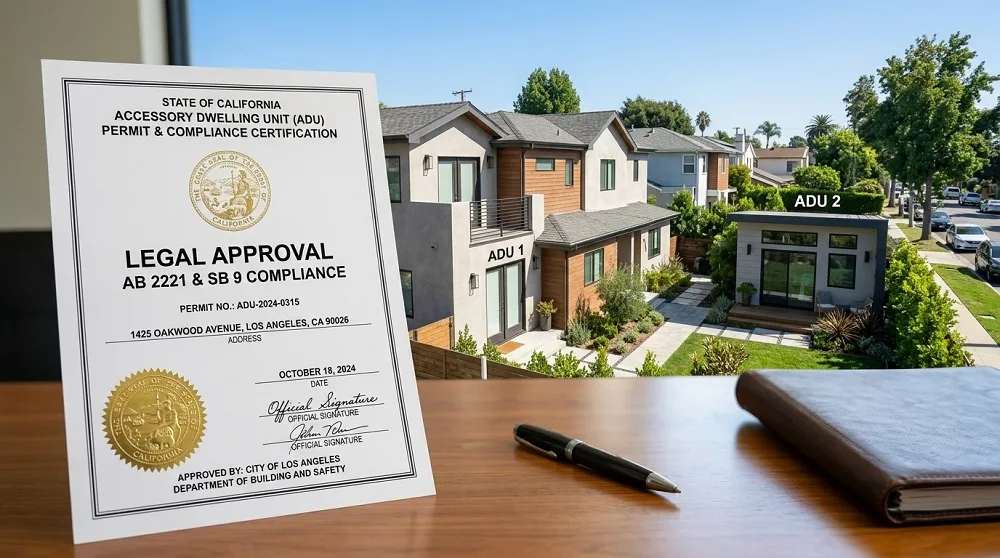
Under California Government Code Sections 66310 through 66342, local agencies must approve, ministerially and without discretionary review, a defined set of ADU combinations on single-family residential lots. SB 543, which took effect January 1, 2026, codified the specific combination that must be permitted: one attached ADU, one detached ADU, and one Junior ADU (JADU) of up to 500 square feet created from within the footprint of the primary dwelling.
This means most single-family property owners in California have a legally guaranteed path to three units on their lot — the primary dwelling plus an ADU and a JADU. Local jurisdictions cannot apply minimum lot size requirements or other subjective criteria to deny that right under Government Code Section 66314.
SB 543 also introduced a significant enforcement mechanism. If a local agency does not determine whether an application is complete within 15 days of submission or fails to approve or deny it within 60 days, the ADU is deemed approved automatically under state law. This gives property owners an important tool when dealing with agency inaction or unnecessary delays.
No owner-occupancy requirement applies to standard ADUs. That protection, established under AB 976, is permanent and continues to apply in 2026. The JADU picture is slightly different: under AB 1154, effective January 1, 2026, owner-occupancy can only be required if the JADU shares sanitation facilities with the primary residence. If the JADU includes its own bathroom, a local agency generally cannot require owner occupancy as a condition of permitting.
Multifamily Properties in 2026
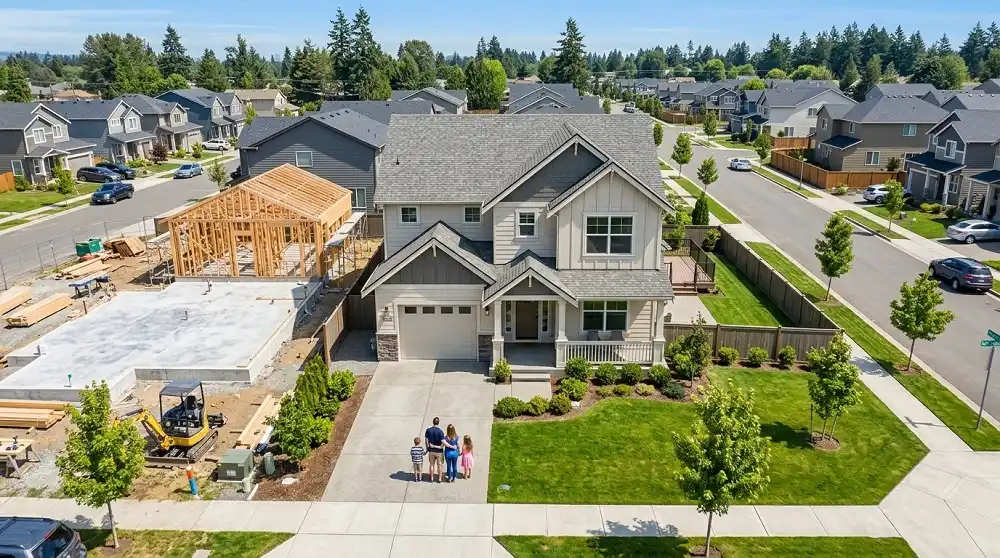
The rules for multifamily properties shifted substantially with SB 1211, which took effect January 1, 2025. This continues to be the governing framework in 2026.
Property owners with existing multifamily structures may build up to eight new detached ADUs, as long as the number of new units doesn’t exceed the number of existing residential units on the lot. A duplex can add two detached ADUs, and a six-unit building can add six. The eight-unit ceiling applies regardless of lot size.
In addition, multifamily property owners can convert existing non-habitable space within the building, such as storage rooms, garages, basements, and similar areas, into ADUs. For this category, the allowance is at least one conversion unit, up to 25 percent of the existing residential unit count. These interior conversions are counted separately from the detached ADU allowance.
One definitional point worth understanding: California's HCD Handbook clarifies that the multifamily rules apply to physically attached residential structures with two or more units. Two single-family homes on the same lot that aren’t connected don’t qualify as a multifamily structure for these purposes, even if the lot is zoned for multifamily use. The City of San Diego has its own local exceptions to this, which we recommend confirming directly with local planning staff before concluding.
The City of San Diego: Local Rules on Top of State Law
The City of San Diego is the only municipality in San Diego County that operates a local bonus ADU program, and that program was substantially revised on August 22, 2025.

Under current City rules, a single-family property owner can add one deed-restricted affordable ADU and receive one additional market-rate bonus ADU in exchange. Combined with the state baseline, this creates a path to up to five units on qualifying lots.
In Sustainable Development Areas, property owners may be allowed one additional market-rate ADU for each qualifying affordable ADU provided, subject to lot area limits and applicable development standards. Properties in Transit Priority Areas may qualify for further allowances, and the forthcoming SB 79 transit corridor provisions — taking effect July 1, 2026 — are worth monitoring for properties near qualifying transit stops in San Diego County.
Effective August 22, 2025, the City of San Diego also formally adopted AB 1033. San Diego County followed, with the Board of Supervisors voting unanimously to adopt the AB 1033 ordinance on March 4, 2026, effective April 4, 2026. AB 1033 allows ADUs to be sold separately from the main residence through a condominium conversion process.
For property owners whose long-term goal is separate ownership instead of ongoing rental, this changes what must be planned for at the pre-construction stage — the unit must be designed and built to meet condominium conversion standards from the start.
For properties in unincorporated San Diego County or in incorporated cities other than the City of San Diego, no local bonus program applies. In those areas, state law sets the maximum allowance rather than a baseline for expansion.
Coastal Zone Properties
For homeowners in San Diego County's coastal areas, AB 462 — effective January 1, 2026 — is a meaningful change. ADU applications within the Coastal Zone that previously required a Coastal Development Permit, a process that could take six to 18 months and carry significant fees, now receive a streamlined 60-day review window.
This brings coastal ADU permitting timelines closer to the standard ministerial process used inland and creates a more practical development path for properties that were previously discouraged by the complexity of the process alone.
Why the Number on Paper Differs from the Number on Your Property
State law and local programs define the maximum that can be permitted. What’s actually achievable on a specific lot is determined by conditions that no statute addresses.
Buildable Area
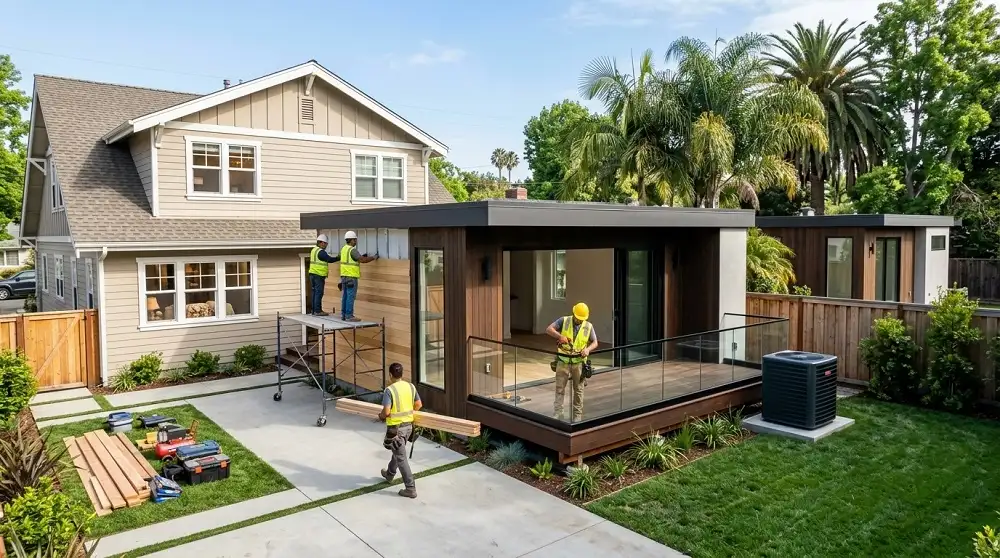
Every ADU requires a usable footprint. California law limits rear and side setbacks for ADUs to a maximum of four feet under Government Code Section 66342. After accounting for setbacks, slope, existing improvements, and easements, the land available for new construction may be considerably less than the lot size suggests.
Utility Capacity
SDG&E requires a separate electric meter for each new ADU in San Diego County, and water and sewer connections must support additional demand. The cost and complexity of those connections depend on where existing lines are relative to the location of the new units.
Unit Count and Applicable Building Code
Properties reaching five or more total dwelling units cross into different regulatory territory. California Business and Professions Code Section 5537 requires a licensed architect or engineer to stamp plans when a property contains more than four dwelling units.
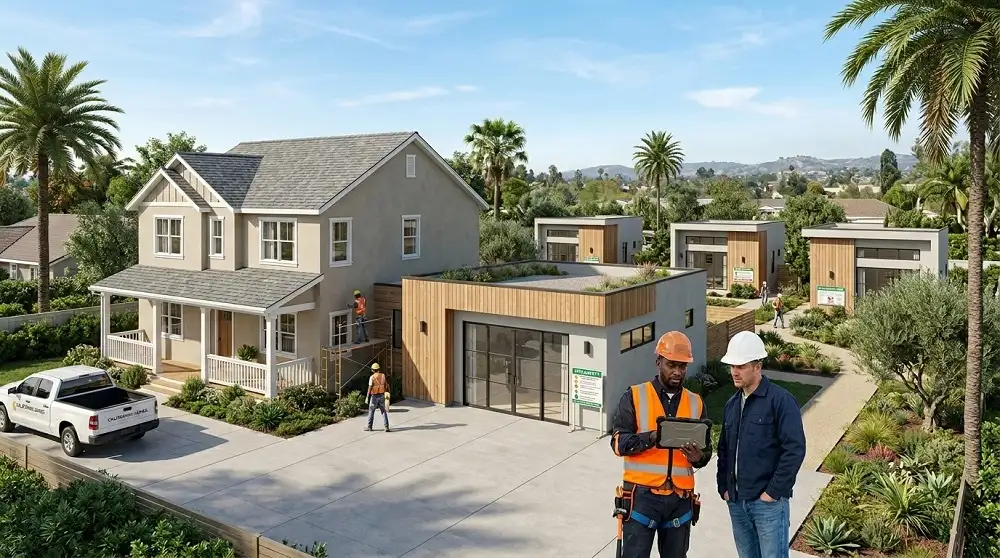
Certain multi-unit configurations may also trigger the California Building Code rather than the California Residential Code, adding fire safety, structural, and energy compliance requirements that impact the project’s scope and budget.
Local Overlays
Fire hazard severity zone designations, coastal overlay conditions, and historic district boundaries apply to certain properties in San Diego County and can impose additional requirements or limit specific construction types entirely.
Property Tax Treatment
Under California's Proposition 13, adding a permitted ADU triggers a reassessment only on the value of the new construction. The primary dwelling's assessed value isn’t affected. Before a project starts, the supplemental assessment for the new unit should be factored into long-term financial planning.
Pre-Construction Steps for a Multi-ADU Project
For property owners looking to maximize ADU potential, the sequence of pre-construction decisions are equally as important as the design.
Confirm Jurisdiction
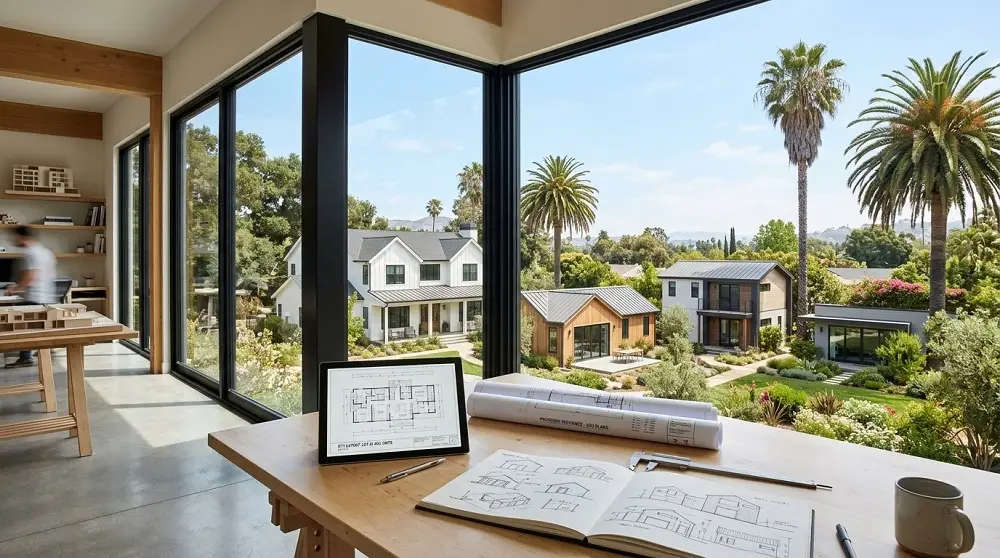
Determine whether the property is within the City of San Diego, unincorporated San Diego County, or another incorporated municipality. The applicable rules are different, and the distinction isn’t always clear from an address.
Establish the Baseline Unit Count
Start with what state law guarantees for the property type, then assess whether any local programs apply. This defines the realistic ceiling before considering site conditions.
Assess the Site
Evaluate buildable area after setbacks, slope, utility access, soil conditions, existing structures, and any overlay zones. This step determines whether the theoretical maximum is achievable on the property.
Define the Development Goal
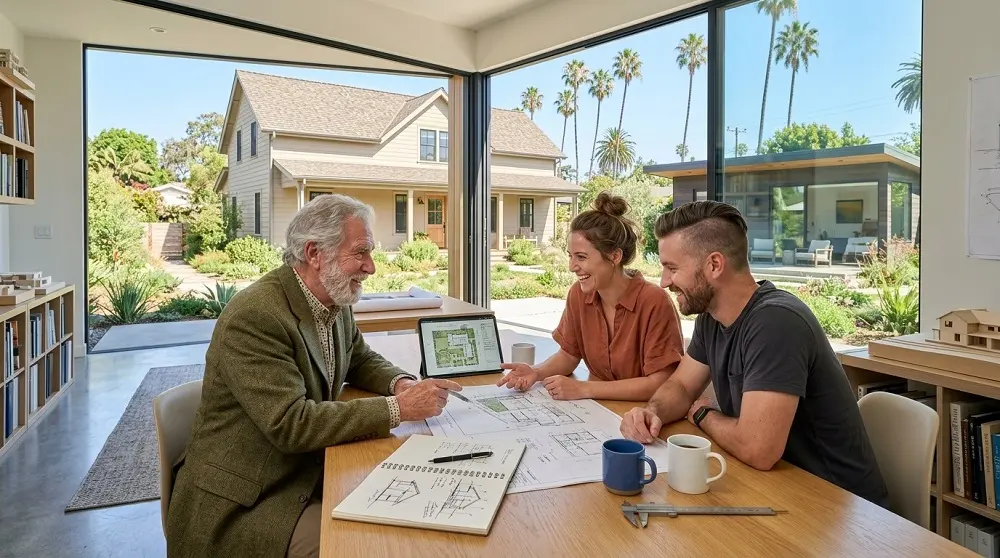
Rental income, multigenerational housing, and eventual separate sale under AB 1033 each result in various design priorities. The goal should be clear before a design is selected, not after.
Address Legal and Ownership Structure Early
For projects involving multiple parties or eventual condominium conversion under AB 1033, resolve title and ownership arrangements with legal counsel before finalizing design decisions.
Prepare a Complete Permit Package
A multi-ADU submission requires site plans, architectural drawings, Title 24 energy compliance documentation, and any engineering required for the site conditions and unit count. For bonus program projects in the City of San Diego, affordability compliance documentation is required as part of the submission.
Moving Forward
The 2026 regulatory environment gives San Diego County property owners more clearly defined ADU rights than at any prior point — and more enforcement tools when local agencies fail to act within required timelines. But the maximum allowed under state law and the maximum a property can realistically support are two different questions. Both should be answered before a project moves into design.
At Streamline Design & Permitting, we work with property owners across San Diego County through the pre-construction decisions that determine how a project turns out: what a property can realistically support, what the permitting process requires in 2026, and how to move forward without avoidable setbacks.