Tenant improvement allowances (TIA) can make the difference between an affordable move-in and a budget disaster. A solid TIA reduces upfront capital requirements and accelerates the timelines of opening your business. Similar to navigating ADU design and permits, understanding tenant improvement allowances requires mastering market rates and negotiation strategies.
In this guide, our team at Streamline Design & Permitting explains how tenant improvement allowances work in commercial real estate, what constitutes a competitive average tenant improvement allowance in California markets, and proven tactics that help you maximize your allowance with confidence.
What Is a Tenant Improvement?
.webp)
A tenant improvement (TI) is any permanent modification to leased commercial space that customizes it for the tenant's business operations. These leasehold improvements typically include walls, flooring, lighting, HVAC upgrades, plumbing, and built-in fixtures that stay with the property after lease termination, unlike portable furniture or equipment.
Permanent modifications to commercial space vary widely based on business needs and existing space conditions. Understanding which improvements landlords typically cover helps tenants plan realistic budgets and negotiate favorable terms.
- Permanent partitions for private offices or conference rooms.
- Upgraded lighting or increased electrical capacity.
- New flooring, ceiling treatments, and wall finishes.
- Restroom or plumbing modifications for ADA compliance.
- Structured cabling, fire alarms, and building-grade systems.
- Built-in cabinetry or integrated specialty lighting.
Unlike portable assets like desks or movable equipment, these improvements remain with the building after your lease term.
What Is a Tenant Improvement Allowance (TIA) and What Does It Cover?
A tenant improvement allowance represents money that the landlord provides to customize leased space. Commercial lease agreements typically express this amount as dollars per rentable square foot or as a fixed lump sum. Payment structures vary, with landlords distributing funds through direct contractor payments, reimbursement after tenant expenditure, or rent credits that offset monthly payments.
What Tenant Improvement Allowances Typically Cover
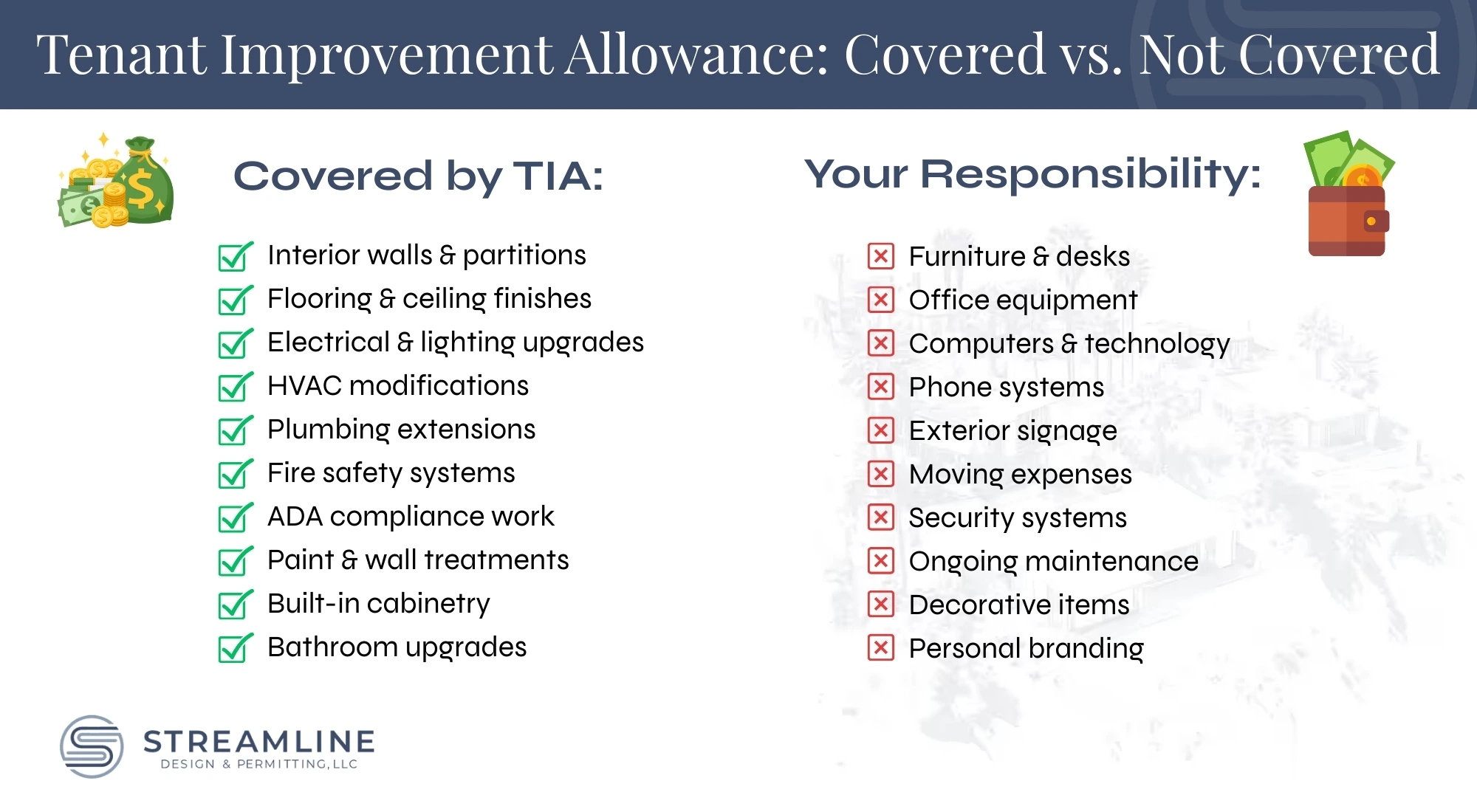
Understanding which improvements fall within standard TIA scope helps tenants budget accurately and negotiate effectively. Typical coverage includes:
- Structural modifications like walls and partitions.
- Infrastructure upgrades, such as electrical and plumbing extensions.
- Finishing touches, including flooring and paint.
- Code compliance improvements ensuring accessibility and fire safety.
These permanent improvements benefit both current operations and increase the value of the leased space for future commercial tenants. Similar to whole-house remodel projects, comprehensive planning ensures all necessary modifications receive adequate funding.
What's Typically Excluded from TIA Coverage?
While tenant improvement allowances cover permanent modifications to leased space, landlords typically exclude certain items from TIA coverage. When you understand these exclusions, you can prevent budget surprises during your commercial lease negotiation.
- Furniture, desks, chairs, and ergonomic furniture.
- Technology equipment, computers, phones, and security systems.
- Exterior signage, logo installations, and branded elements.
- Moving costs, transportation, and relocation expenses.
- Ongoing maintenance, repairs, and operating expenses.
Commercial lease agreements should clearly specify landlord-covered improvements versus tenant-funded expenses to avoid disputes during the construction process.
Average Tenant Improvement Allowance: What to Expect
The average tenant improvement allowance varies significantly based on factors like commercial real estate market conditions, building class, property type, and lease terms. Understanding these ranges helps quality tenants evaluate whether proposed allowances reflect competitive market value and support realistic build-out expectations.
National Averages and Market Variation
General commercial property averages span $20-$60 per square foot for typical office tenants seeking standard finishes. Premium urban markets like San Francisco frequently exceed $75 per square foot, with some Class A commercial buildings in competitive office markets offering allowances surpassing $100 per square foot to attract tenants with strong credit profiles.
Secondary markets and suburban locations typically offer lower tenant improvement costs that range from $15-$40 per square foot, based on local real estate market conditions and landlord negotiating power.
Allowances by Property Type
Different commercial space categories command varying tenant improvement allowances based on typical construction requirements and market expectations.
Office space commonly receives $30-$70 per square foot, depending on finish requirements and whether tenants require private offices versus open workspace. Retail spaces typically secure $20-$50 per square foot based on location visibility. Industrial properties generally provide leaner allowances of $15-$30 per square foot due to simpler finish requirements and cold shell space conditions.
Medical and laboratory facilities need specialized systems that result in tenant improvement allowances, often reaching $50-$100+ per square foot, to accommodate complex infrastructure needs.
This market knowledge proves essential when you’re evaluating whether proposed allowances reflect current commercial real estate conditions and competitive value for your specific business needs.
Understanding Tenant Improvement Costs per Square Foot
Actual tenant improvement costs per square foot showcase the real construction expenses needed to transform leased property into your operational environment. These costs include both hard costs for physical construction and soft costs for professional services, with tenants potentially covering construction costs that exceed the landlord's allowance.
Hard Costs vs. Soft Costs
Where does the money go? Breaking down tenant improvements into cost categories helps tenants analyze the allocation and identify potential savings opportunities without compromising quality.
- Hard costs: Encompass demolition, construction labor, MEP systems (mechanical, electrical, plumbing), interior finishes, and specialized equipment installations. These direct construction expenses typically constitute 75-90% of total project investment.
- Soft costs: Include architectural fees, engineering services, building permit services and permit fees, inspections, legal fees, and project management. These professional services generally represent 10-25% of total tenant improvement costs.
Understanding this split helps tenants budget accurately and avoid cost overruns that strain business capital during the critical move-in period.
Cost Ranges by Project Complexity
Construction expenses vary dramatically based on existing space conditions and desired finish levels across different commercial space types.
Basic office refresh projects that include paint, carpet replacement, and lighting updates typically cost $20-$50 per square foot. Mid-range build-outs that need new partitions for private offices and upgraded finishes range from $50-$120 per square foot. High-specification projects for medical facilities or laboratories often exceed $120-$300+ per square foot due to complex infrastructure requirements.
The best approach is to get competitive bids from multiple contractors. This ensures accurate cost projections and identifies savings opportunities within your tenant improvement budget while still prioritizing quality.
How to Calculate Your TI Budget
Accurate budget calculation prevents surprises during your commercial lease build-out and helps determine whether the landlord's tenant improvement allowance is adequate to cover your space requirements. A systematic approach ensures comprehensive cost estimation before you sign any lease agreements.
- Measure the space: Determine rentable versus usable square footage, as tenant improvement allowances are typically calculated based on rentable square feet.
- Define scope: Create a comprehensive list of required permanent improvements, including walls, MEP upgrades, restrooms, conference rooms, and code compliance work.
- Obtain contractor estimates: Secure at least three competitive bids for hard costs to establish realistic construction pricing.
- Add soft costs: Include architectural fees, engineering services, permit fees, and project management expenses (10-25% of hard costs).
- Include contingency: Reserve 10-20% for unforeseen conditions and code-related requirements.
- Compare to the offered TIA: Calculate whether the landlord's allowance covers projected costs, or if you'll fund the gap.
Showing solid revenue projections strengthens your position when asking landlords for higher tenant improvement allowances.
Accounting and Tax Implications
Tenant improvement allowance accounting requires careful attention, as financial and tax treatment have a significant impact on both tenants and landlords. For tenants, the TIA may appear as a liability on balance sheets, with amortization impacting income statements. Tax implications vary, as certain improvement costs may qualify for deductions while others affect taxable income differently.
Generally, landlords treat tenant improvement allowances as capital expenditures eligible for depreciation, providing tax benefits. Both parties should consult tax professionals to stay compliant and make the most of their financial outcomes.
Creative Strategies to Stretch Your TIA

When your tenant improvement allowance falls short of ideal specifications, strategic approaches can maximize value without compromising essential business functionality.
Phased Build-Outs, Landlord-Paid Turnkey, and Rent Credits
Several alternatives help bridge gaps between offered allowances and actual tenant improvement costs while preserving capital for business operations.
- Phased build-outs: Prioritize essential improvements using the landlord's allowance immediately, deferring upgrades until business cash flow strengthens.
- Landlord-paid turnkey build-outs: Shift construction management to the property owner, who often secures better vendor pricing through established relationships.
- Rent credits: Provide another effective strategy when landlords resist increasing allowances, freeing tenant capital for construction without raising long-term lease costs.
Tradeoffs: More TIA vs. Rent Increases
Higher tenant improvement allowances rarely come without cost. It’s common for landlords to offset increased allowances through higher rental rates, steeper rent escalations, or longer lease terms. Before accepting enhanced allowances, analyze the total occupancy cost over your entire lease agreement. Sometimes, contributing additional capital initially is more economical than paying elevated rent for years.
Make Your TIA Work for You
Understanding local tenant improvement allowances, calculating costs correctly, and recognizing that TIAs are landlord contributions can strengthen your negotiating position.
Streamline Design & Permitting provides comprehensive support from space planning through permit approval for residential and commercial projects. You won’t have to walk the confusing maze of regulations and requirements alone. Contact us today to maximize your investment.


.webp)